Why a Classic Framework Still Deserves Your Attention
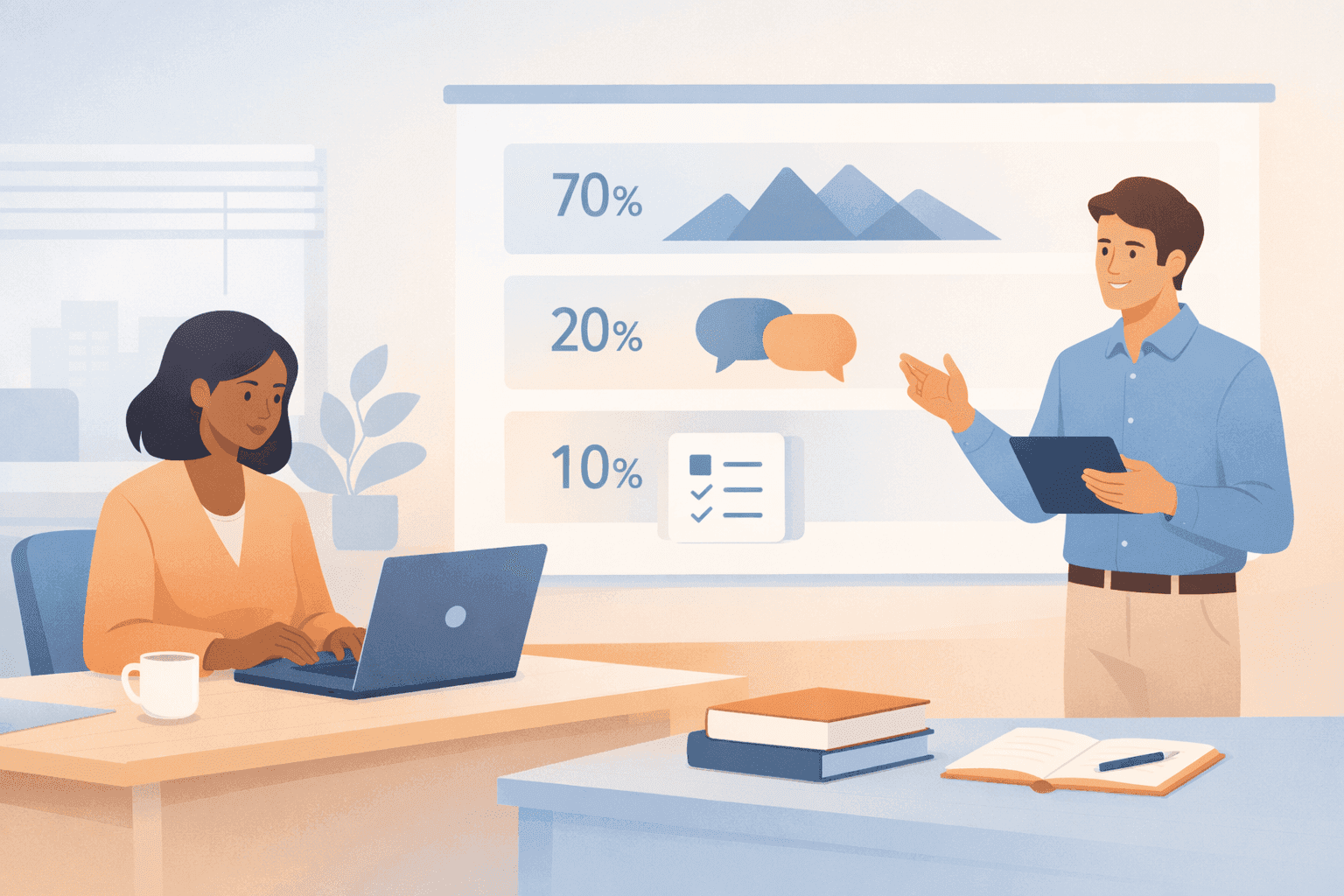
If you’ve spent any time building training programs lately, you know the clock always seems to run faster than project timelines. New hires need to ramp yesterday, compliance refreshers loom, and your team is expected to do more with less. One perennial compass for learning designers is the 70‑20‑10 model—the idea that effective development happens roughly 70 % on the job, 20 % through social interactions, and 10 % via formal training.
But what happens when you combine that framework with today’s AI‑powered authoring tools? You get a blended‑learning engine that’s faster, smarter, and surprisingly budget‑friendly. This article breaks down the model, shows how artificial intelligence supercharges each component, and offers practical steps for putting the blend to work in your organization.
What Exactly Is the 70‑20‑10 Model?
First described by researchers at the Center for Creative Leadership in the 1980s, the model emerged from interviews with high‑performing managers on how they learned new skills. Roughly:
- 70 %: Stretch assignments, problem‑solving, and day‑to‑day challenges
- 20 %: Coaching, feedback, and peer conversations
- 10 %: Structured courses, workshops, and reading
Think of it less as hard math and more as a reminder that most professional growth happens outside the classroom—and that formal courses are just one slice of a larger pie.
Why the Model Still Matters in 2025
- Business Relevance. Learning in the flow of work shortens the distance between “I learned it” and “I used it,” boosting productivity and retention.
- Employee Engagement. Social feedback loops and hands‑on practice make learning contextual and stickier than slide decks alone.
- Talent Retention. According to LinkedIn’s 2025 Workplace Learning Report, 94 % of employees would stay longer at a company that invests in their growth.
- Scalability at Any Size. Companies from Unilever to growing tech firms lean on 70‑20‑10. Unilever’s global media function openly champions the model, offering cross‑function secondments to nail the 70 % experiential piece.
Bottom line: the ratios aren’t sacred, but the principle—that blended, everyday learning wins—is timeless.
So what does ‘blended’ look like in a digital world? Enter AI.
Enter AI Authoring Tools: A Quick Primer
AI authoring platforms use machine learning and large‑language models to draft, assemble, and adapt digital learning content in minutes instead of weeks. Here’s a snapshot of what’s possible:
Capability
What It Means for L&D
Real‑World Example
Rapid content drafting
Auto‑generate outlines, storyboards, and quizzes
Mindsmith turns bullet points into SCORM‑ready micro‑courses
Adaptive branching
Learners skip what they’ve mastered; focus on gaps
Smart LXPs like Docebo Shape
Simulation & role‑play
Lifelike conversation practice without risk
Vistio ServiceSim for contact‑center agents
Real‑time feedback
Instant coaching suggestions
Second Nature for sales reps
Notice how each feature naturally supports at least one slice of 70‑20‑10—more on that next.
Blending 70‑20‑10 and AI: A Section‑by‑Section Guide
1. Super‑charging the 70 %: Experiential Learning
- AI Simulations. Tools like ServiceSim let agents battle a cranky virtual customer until they crack the perfect resolution—safe, repeatable, and logged for review.
- Just‑in‑Time Bots. Picture an AI sidekick inside your CRM whispering product specs the moment a rep hesitates. That’s experiential micro‑learning on demand.
- Performance‑Triggered Challenges. When KPIs dip, the system nudges managers to assign a project that strengthens the weak area, turning metrics into curated stretch assignments.
2. Amplifying the 20 %: Social & Peer Learning
- AI‑Curated Mentoring Matches. Some platforms analyze profiles and auto‑suggest mentors who’ve mastered the skill a learner just practiced.
- Feedback at Scale. After a simulation, the AI packages highlights so human coaches can discuss insights instead of scrubbing video.
- Smart Discussion Threads. An LXP surfaces relevant peer Q&As, saving learners from spelunking stale forums.
3. Turbo‑Boosting the 10 %: Formal Training
- Rapid Module Creation. Mindsmith converts a policy PDF into a polished lesson—complete with knowledge checks—in under an hour (Training Magazine interview).
- Adaptive Pathways. AI quizzes learners and dynamically skips content they already know. Tools like Docebo Shape and Axonify make this possible keeping courses lean and personalized.
- Instant Updates. Change a regulation? AI finds every instance in the curriculum and patches it, no version‑control chaos.
Five Best Practices for Rolling Out an AI‑Enhanced 70‑20‑10 Strategy
- Audit Before You Automate. Map existing learning to the 70‑20‑10 buckets; spot gaps AI could fill.
- Start Small, Pilot Fast. Pick one pain point—like slow compliance content—and run a four‑week AI pilot.
- Upskill Your Team. Give instructional designers and learning architects sandbox time with the new tool; creativity follows confidence.
- Blend, Don’t Bolt‑On. Link formal modules to simulations and mentoring prompts so learning flows instead of fragments.
- Measure What Matters. Track cycle‑time saved, practice hours logged, and post‑training performance, not just completion rates.
Conclusion: Your Next Step Toward Smarter Blended Learning
Classic wisdom says we learn mostly by doing. Modern tech says we don’t have to build “doing” from scratch. By marrying the 70‑20‑10 framework with AI authoring tools, learning professionals can deliver content faster, embed practice into everyday workflows, and spark richer peer conversations—all without ballooning headcount or budget.
Ready to put theory into practice? Book a 15‑minute live demo or start a free trial. You’ll receive sandbox access plus a concise quick‑start guide so you can launch your first AI‑enhanced module this quarter and begin tracking faster ramp‑up times—your learners and your leadership team will thank you.
Frequently Asked Questions
Is the 70‑20‑10 split a rule or a guideline? A guideline. The idea is to maximize experiential and social learning, not to chase exact percentages.
Do AI tools replace human coaches? No. They automate the busywork so coaches can focus on high‑value feedback and mentoring.
Can agile teams afford AI authoring? Yes. Many solutions (including Mindsmith) use tiered pricing—no enterprise budget required.