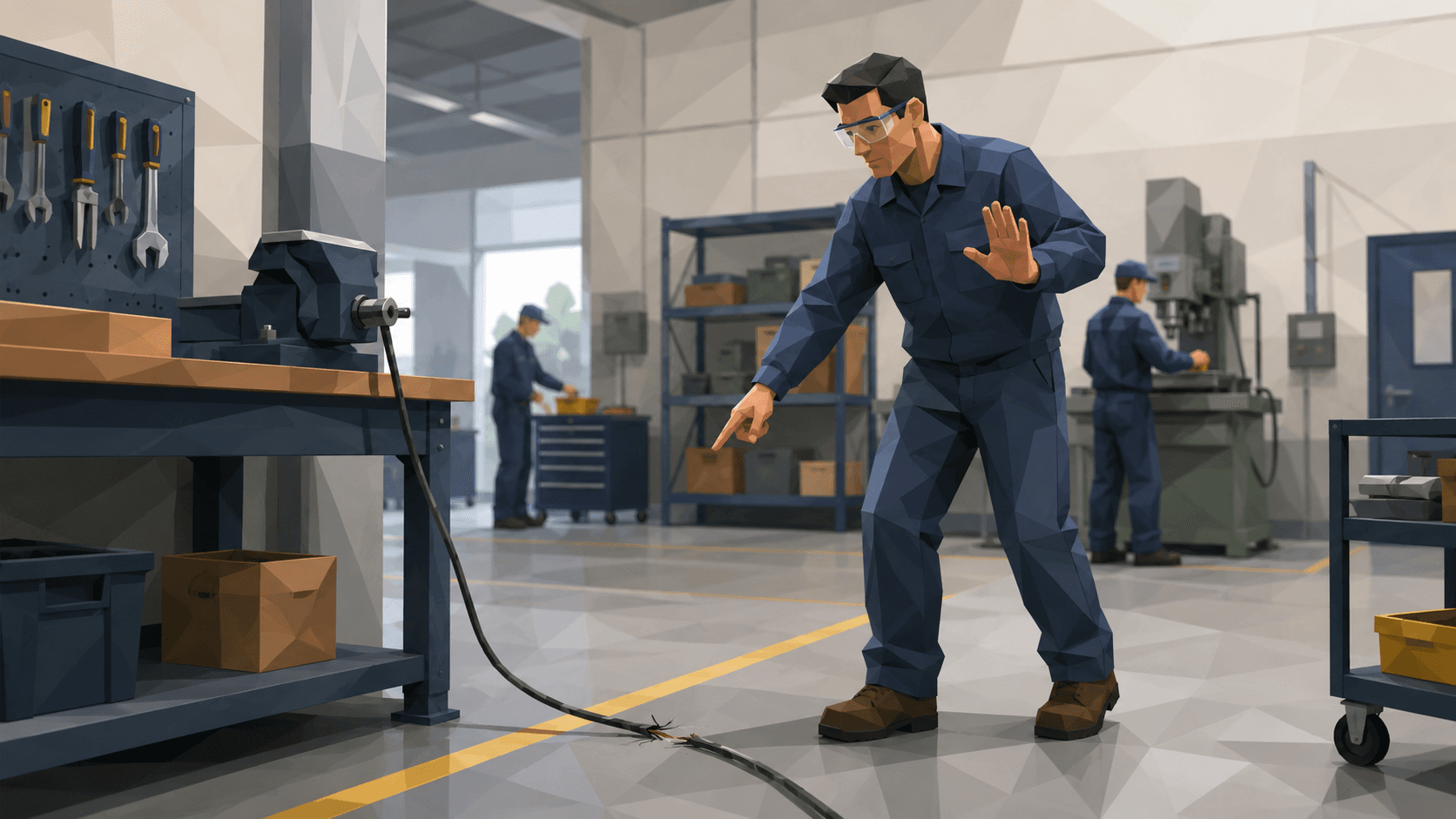
Ask most employees what they remember from their last safety training and you'll get a shrug. They clicked through it. They passed the quiz. They could not tell you, a week later, what to actually do if they found a frayed cable or smelled gas. The training was completed. Nothing was learned.
This is the central problem with workplace safety training: the easiest thing to measure is completion, but completion has little to do with what matters most, which is how someone behaves when a hazard appears. A training program can reach 100% completion and still fail the only test that truly counts.
This guide is about closing that gap: how to design safety training that changes what people do, not just what they've clicked.
Why "Checkbox" Safety Training Fails
The default safety course is built to satisfy a requirement, not to teach. It's a wall of regulations, a narrated slide deck, and a multiple-choice quiz lenient enough that everyone passes. It exists so the organization can prove training happened.
The trouble is that hazards do not appear as multiple-choice questions. They appear as split-second judgment calls on a noisy floor, often when someone is tired or rushed. Knowledge memorized for a quiz but never practiced rarely survives that moment. Worse, checkbox training quietly teaches a second lesson: that safety is merely a formality to get through. That is exactly the opposite of the safety culture you are trying to build.
Start With the Behaviors, Not the Regulations
Effective safety training works backward from the moment of risk. Before writing a single slide, ask: what do people actually need to do differently on the floor? Spot a specific hazard, follow a specific shutdown sequence, report a near-miss instead of shrugging it off.
Those concrete behaviors become your learning objectives. Regulations still matter because they define the minimum legal requirements you must meet. However, they should serve as the source material rather than the lesson plan. A course organized around what workers need to do and recognize is far more effective than one organized around what the standard says.
Use Real Scenarios and Real Decisions
The single biggest upgrade you can make to safety training is replacing passive reading with active decision-making. Instead of simply telling someone the correct procedure, place them in a realistic situation, let them choose what to do, and then show them the consequence of that choice.
Scenario-based branching training works because it rehearses the exact skill the real moment demands: noticing a hazard and deciding how to respond. A learner who has worked through a situation such as, “You arrive at a machine that is still running and the guard is off. What do you do next?” and seen where each choice leads is far better prepared than someone who only read a paragraph about machine guarding. The mistakes happen safely on screen, where they carry no real-world cost.
This is also where training earns attention. People lean into a decision that feels real. They click through a lecture.
Make It Specific to Your Workplace
Generic safety training is weak safety training. The hazards in a chemical plant, warehouse, and commercial kitchen are not the same. A course that covers only general principles leaves the most important details, including your organization’s actual risks, to the learner’s imagination.
The fix is to ground the training in the real environment: the equipment your people use, the layout they move through, the incidents that have actually happened or nearly happened on your site. Foundational content gives you a strong starting point, but the version that changes behavior is the one customized to the specific work.
A note on compliance: covering core safety topics is necessary, but meeting your obligations under OSHA and other regulations depends on addressing the hazards specific to your workplace and industry. Treat any starting template as a foundation to adapt and validate against your own requirements, not as a guarantee of compliance.
Reinforce, Measure What Matters, and Repeat
Behavior change rarely survives a single session. The strongest safety programs reinforce key practices over time through short refreshers, periodic scenario check-ins, and visible follow-through when someone reports a hazard. This helps the right response become a reflex rather than something workers must struggle to recall.
Measurement should also go beyond completion rates. Are near-miss reports increasing? That can be a positive sign that people are paying closer attention. Are incidents trending downward? These outcomes provide a much clearer picture of whether the training is doing its real job.
Building It Without Burning Weeks
Designing scenario-rich, workplace-specific safety training sounds like a lot of work because, traditionally, it has been. Branching scenarios in particular have always been expensive to build by hand.
Mindsmith's Workplace Safety Essentials template gives you a scenario-based foundation covering core safety topics, which you can then adapt to your site’s real hazards using the AI-native editor. Building the branching decision points that make safety training effective takes an afternoon rather than a month. This allows your designers to focus on the judgment calls that matter instead of spending their time assembling slides.
For the related compliance training most organizations need alongside it, see our guides on lockout/tagout training and code of conduct training.
Safety training has one real job: making sure people go home unharmed. That's worth building well.
Build safety training that sticks — free →
This article is for general informational purposes and does not constitute legal or compliance advice. Consult your safety and legal teams to ensure training meets your obligations.