For years, organizations have relied on completion rates to gauge training success. But let’s be honest—just because someone finishes a course doesn’t mean they actually learned anything. It’s like assuming someone who watched an entire cooking show can suddenly whip up a Michelin-star meal.
The real challenge? Traditional tracking methods offer surface-level insights, leaving learning professionals in the dark about actual engagement, comprehension, and skill application. Fortunately, AI-powered learning analytics are changing the game.
This article explores how AI moves beyond outdated metrics, provides deep learning insights, and how Mindsmith’s AI-powered tracking helps learning architects design more effective eLearning experiences.
The Problem: Why Completion Rates Are Not Enough
Think of completion rates as participation trophies—they look good on paper, but they don’t tell the full story. A course with a 95% completion rate might seem successful, but what if:
- Half the learners clicked through without absorbing anything?
- Others multitasked their way through it?
- The assessment questions were so easy that passing was inevitable?
Studies have shown that **engagement is a stronger predictor of knowledge retention than mere completion**. Yet, many organizations still use outdated Learning Management Systems (LMS) that don’t track what truly matters—active engagement, time spent on activities, or interactions with content.
According to a report by SHRM, organizations that implement data-driven learning strategies experience up to a 40% improvement in workforce productivity. Clearly, relying on completion rates alone is a missed opportunity for businesses aiming to develop a skilled workforce.
AI-Powered Learning Analytics: A Smarter Approach
Artificial Intelligence (AI) in learning analytics is revolutionizing how we measure training effectiveness. Instead of tracking who finished a course, AI analyzes how they engaged, what confused them, and where they needed additional support.
1. Tracking True Engagement
AI doesn’t just check if learners viewed a slide—it measures:
- Time spent per module (Did they skim or dive deep?)
- Interactive element engagement (Did they answer practice questions?)
- Rewatch behavior (Which parts did they revisit?)
For example, AI-driven learning platforms like Mindsmith analyze micro-interactions, identifying sections where learners struggle, then dynamically adjusting the content to improve comprehension.
A case study by Hyperspace demonstrated that organizations implementing AI-powered engagement tracking saw a 40% increase in learner engagement and a 30% improvement in knowledge retention. By leveraging AI-driven adaptive learning systems, employees received personalized training experiences that responded dynamically to their interactions, significantly enhancing retention rates.
2. Personalized Learning Paths
AI can tailor content based on individual performance. If a learner excels in one area but struggles in another, the system adapts their journey—offering additional practice where needed, skipping redundant sections, and recommending relevant resources.
A study at UniDistance Suisse introduced an AI tutor that provided personalized, real-time feedback to learners. Active engagement with the AI tutor led to significantly higher grades, with an average improvement of up to 15 percentile points compared to a parallel course without the AI tutor, as employees spent time on areas that mattered to them rather than rehashing known material.
3. Predictive Analytics for Proactive Interventions
Instead of waiting until a course is complete to analyze effectiveness, AI enables real-time insights. If learners are disengaged, AI can trigger nudges—reminders, additional explanations, or interactive elements to re-engage them before they drop off.
A study demonstrated that machine learning models could predict learner dropout with 82%-94% accuracy based on early interactions, enabling organizations to intervene before learners disengage completely. By analyzing early indicators—such as login frequency, quiz attempts, and time spent on learning materials—AI can flag at-risk learners before they drop off.
For example, an AI-powered LMS could detect that a learner has skipped critical videos or has repeated quiz failures. In response, automated interventions—such as adaptive feedback, personalized learning paths, or nudges from an instructor—can be triggered in real time. Organizations using this method in workplace training have seen improved retention rates and reduced training dropouts, as employees receive timely support when they struggle instead of waiting for post-course evaluations.
Mindsmith’s Role: Smarter Learning Analytics in Action
Mindsmith’s AI-powered analytics equip learning designers with actionable insights to enhance training effectiveness. While it does not offer real-time adaptive interventions, it helps organizations refine content and engagement strategies based on data-driven recommendations.
Key capabilities include:
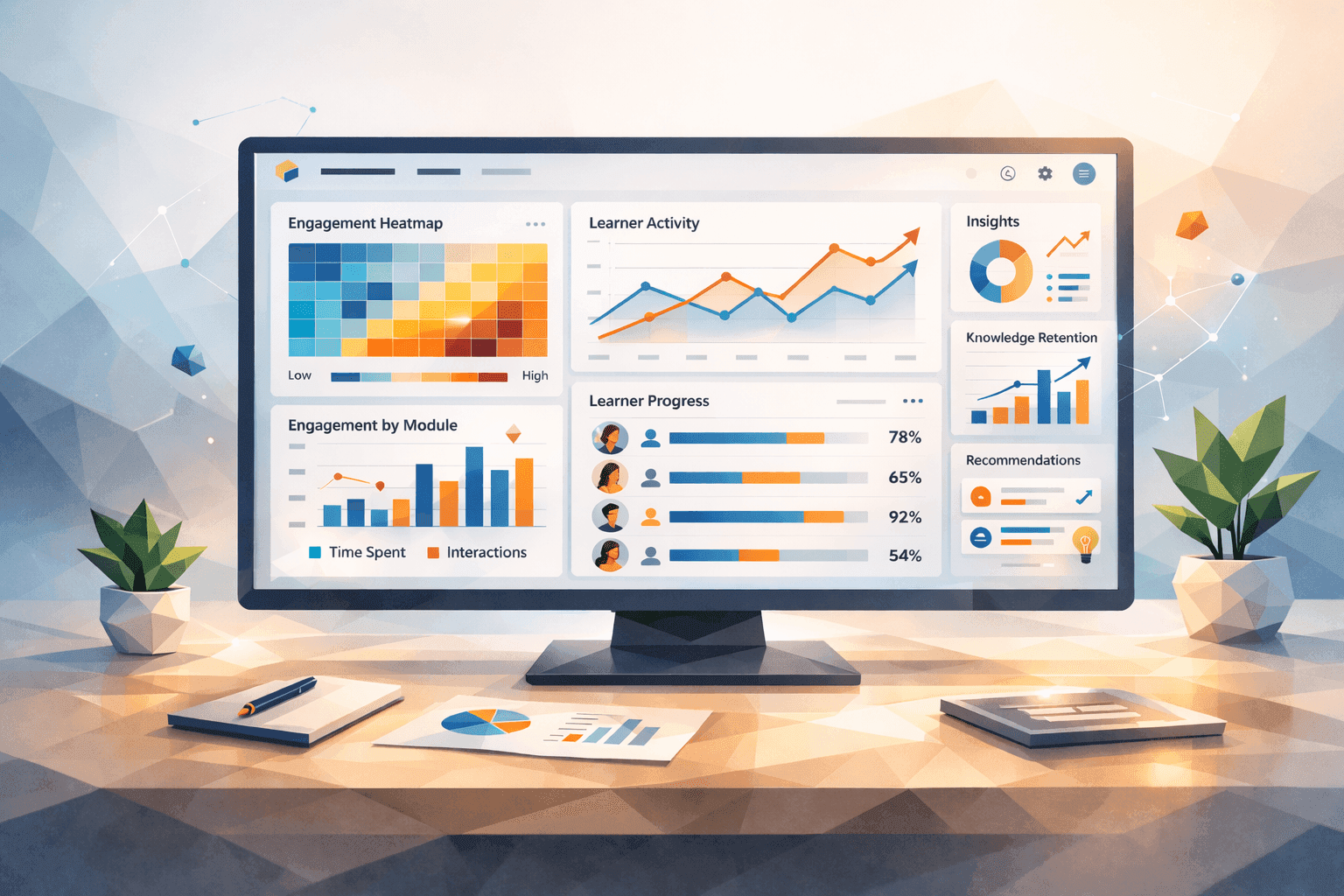
- Engagement Heatmaps – Identify which slides or videos capture attention versus those frequently skipped.
- Concept Reinforcement – Analyze quiz performance trends to help training teams refine content for better comprehension.
- Content Optimization Suggestions – Detect patterns in learner engagement, providing insights to adjust materials for improved retention.
By leveraging Mindsmith’s AI-powered analytics, organizations can transition from surface-level tracking to a deeper, more meaningful understanding of learner interactions—helping them design more engaging and impactful training experiences.
Benefits of AI-Powered Learning Analytics for Organizations
By shifting from completion rates to AI-driven insights, organizations gain:
✅ Higher ROI on training – Data-driven learning analytics enable organizations to measure training effectiveness beyond completion rates. By identifying what works and what doesn’t, L&D teams can invest in programs that truly enhance skills and drive business performance.
✅ Improved Learner Retention and Engagement – AI analytics track real-time engagement, helping identify which content resonates with learners and which sections need improvement. By adjusting training based on engagement data, organizations can reduce dropout rates and keep employees invested in their learning journey.
✅ Personalized Learning Pathways – AI-powered analytics help organizations move away from one-size-fits-all training. By analyzing learner behaviors, AI provides insights into individual learning needs, enabling the creation of customized training experiences that cater to different skill levels and knowledge gaps.
✅ Data-Driven Decision-Making – With AI, organizations can make evidence-based learning decisions. Instead of relying on assumptions, L&D teams can track content performance, learner behaviors, and skills progression, allowing for continuous course optimization and more effective workforce development.
Getting Started with AI-Powered Learning Analytics
Ready to move beyond outdated metrics? Here’s how:
- Define Key Engagement Metrics – Move beyond “Did they finish?” to “Did they engage meaningfully?” Metrics like interaction levels, knowledge retention rates, and time spent on content provide deeper insights into learner success.
- Adopt AI-Powered Tools – Platforms like Mindsmith help track deep learning insights, offering data on engagement patterns and content effectiveness to refine training programs.
- Leverage Data for Continuous Improvement – AI insights enable L&D teams to adapt training content dynamically. Organizations that regularly analyze learning data can proactively improve course material, ensuring long-term engagement and knowledge retention.
By integrating AI-powered learning analytics, organizations can enhance workforce training, boost productivity, and drive continuous learning improvements.
Next Steps
Take a moment to assess your current training metrics—are they truly measuring engagement, or just tracking completions? Identify areas where deeper insights could improve learning outcomes. Consider how AI-powered analytics can enhance your approach, whether through better engagement tracking, personalized learning paths, or data-driven improvements.
Conclusion
The future of learning analytics isn’t about completion rates—it’s about understanding real engagement and learning outcomes. AI is unlocking new levels of insight, allowing learning architects to design more effective and adaptive training experiences by leveraging data-driven engagement metrics. By tracking real-time interactions, analyzing learner behaviors, and identifying content gaps, AI-powered analytics enable organizations to refine their training programs for better retention and skill development.
Want to see AI-powered analytics in action? Try Mindsmith today with a free trial and discover how data-driven insights can elevate your training programs.