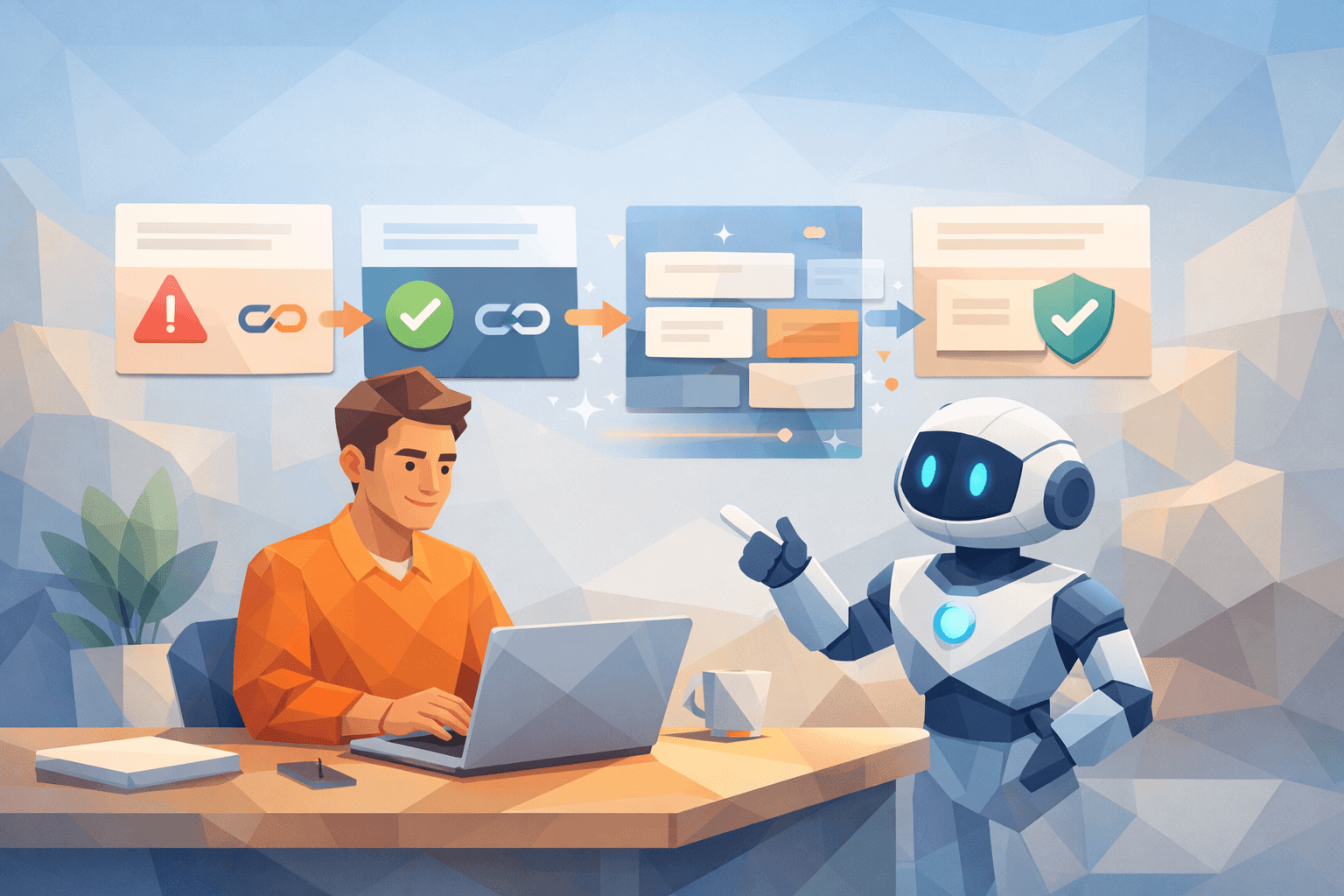
You know that moment when you open a document you haven't touched in months and realize it's full of outdated info, missing links, or policies that no longer apply? Now imagine that happening across dozens—or hundreds—of training modules your team relies on.
Keeping content fresh isn’t just a professional best practice—it’s a daily challenge most learning professionals face. Whether it’s a policy update, a broken link, or a shift in regulations, updates come fast and often. But with multiple versions, languages, and compliance requirements to juggle, maintaining it all manually can feel overwhelming and nearly impossible to scale.
Fortunately, AI is stepping in to help. With the right tools, you can automate updates, improve accuracy, and free up your team to focus on higher-impact work.
This article explores how AI-powered authoring tools like Mindsmith are changing the game—making content updates faster, smarter, and more manageable for busy L&D teams.
How AI Streamlines eLearning Content Updates
1. AI-Powered Content Automation
AI-driven tools analyze existing course materials and automatically suggest updates. Instead of manually identifying outdated content, AI scans documents, detects obsolete information, and recommends revisions. Mindsmith’s AI-powered engine helps learning professionals efficiently update lessons by identifying outdated content, suggesting revisions, and aligning training materials with the latest industry standards and policies.
2. AI-Generated Summaries and Content Enhancements
AI tools can analyze entire courses and provide updated summaries or highlight areas requiring revision. Learning professionals can use AI-generated recommendations to refine course materials and improve clarity without starting from scratch.
3. Automated Compliance and Regulatory Updates
AI tracks legal and compliance changes in real time. When new regulations emerge, AI-powered tools suggest modifications to training content, ensuring organizations stay compliant without delays.
4. Multilingual Content Updates with AI Translation
AI automates translation updates, ensuring that changes in the original course are accurately reflected across all languages. AI-powered localization tools reduce translation turnaround time while maintaining linguistic accuracy.
5. Adaptive Learning Enhancements
AI continuously analyzes learner data to identify areas where training content can be improved. It detects underperforming sections and suggests interactive enhancements such as quizzes, videos, or microlearning modules to boost engagement.
The Challenges of Updating eLearning Content Manually
1. Slow and Costly Revisions
Revising traditional eLearning materials is labor-intensive. Instructional designers must manually edit text, update media, and review compliance changes before republishing courses. This process can take weeks or months, leading to increased costs and outdated content remaining in circulation longer than it should.
2. Maintaining Consistency Across Training Programs
Organizations that manage multiple courses struggle with version control. Keeping training materials consistent—especially when policies, procedures, or branding guidelines change—becomes a logistical challenge. Without a centralized system, inconsistencies can confuse learners and reduce content credibility.
3. Compliance and Regulatory Risks
Industries like finance, healthcare, and IT require frequent training updates to align with changing regulations. Delays in revising compliance courses can result in legal risks, non-compliance penalties, and misinformation among employees.
4. Multilingual and Global Training Complexities
For organizations with international teams, updating translated courses adds another layer of difficulty. When the source content changes, translations must be revised accordingly. Traditional translation workflows are slow, costly, and prone to inconsistencies.
Real-World Applications: AI-Powered Content Updates in Action
Case Study 1: Morgan Stanley’s AI Assistant Streamlines Financial Training
Morgan Stanley implemented an AI-powered assistant based on GPT-4 to help financial advisors quickly retrieve, generate, and update training and client materials. By automating content generation from a knowledge base of over 100,000 documents, the assistant reduced proposal creation time by over 90%—from 9 hours to just 30 minutes. This not only boosted advisor productivity but also ensured training content remained accurate and consistently updated across the organization.
Case Study 2: University of Mississippi Streamlines Healthcare Course Updates with AI
The University of Mississippi School of Pharmacy used generative AI to refresh an online Pharmacy Ethics course. Professor Patricia O’Sullivan integrated tools like Perplexity and her LMS’s built-in AI to generate up-to-date summaries of new healthcare laws and court cases, as well as auto-generate quiz questions. This significantly accelerated the process of updating both content and assessments. She reported that the AI-assisted workflow allowed her to revamp the entire course in one term—a task that would have been impractical without AI support.
Case Study 3: AI-Assisted Language Localization for Global Workforce Training
Lindner Group, a multinational construction firm, implemented imc Express, an AI-powered authoring tool, to empower regional teams to transform documents into localized eLearning modules. Within 18 months, over 200 courses were created and translated into multiple languages—dramatically accelerating content production. The initiative led to a 40% increase in LMS usage, with subject-matter experts now able to update training content independently. This decentralized approach not only kept materials current across regions but also fostered collaboration between global offices.
How to Implement AI-Powered Content Updates in Your Organization
1. Choose an AI-Powered Authoring Tool
Start by selecting an AI-powered authoring tool that fits your organization’s goals. Look for features such as automated content analysis, natural language generation, built-in translation capabilities, and compliance monitoring. Mindsmith, for example, provides real-time revision suggestions and supports rapid content iterations by analyzing outdated material and aligning updates with evolving standards.
When evaluating tools, consider how intuitive the interface is for non-technical users, the ability to integrate with your existing LMS, and whether the AI provides content improvement suggestions based on learner data.
2. Develop an AI-Assisted Content Management Strategy
Implement a structured approach to managing AI-assisted updates. This includes:
- Establishing regular content audit cycles to flag outdated or underperforming modules.
- Assigning roles for reviewing and approving AI-suggested updates to maintain instructional quality.
- Creating a feedback loop where subject-matter experts validate AI-generated changes.
Define KPIs to measure content freshness, learner performance, and update turnaround times. Documenting these workflows ensures alignment across L&D, compliance, and content teams.
3. Use AI-Generated Analytics to Improve Course Effectiveness
Leverage AI analytics to go beyond basic completion rates. Look for patterns in learner engagement, quiz performance, and interaction heatmaps. AI can highlight:
- Content sections where learners drop off or show low comprehension.
- Opportunities for microlearning or branching scenarios based on user behavior.
- Automated alerts when training modules are underperforming.
By acting on these insights, you can proactively revise and optimize learning content—improving both learning outcomes and organizational ROI.
Conclusion: AI-Powered Content Updates Are the Future of eLearning
Staying current is no longer optional. Outdated training content can quietly erode learner trust, increase compliance risk, and hold back business agility. AI-powered authoring tools like Mindsmith offer a better way forward—removing friction from course maintenance and giving learning professionals more time to focus on meaningful design and learner impact.
Making the shift now means you're not playing catch-up later. The sooner you adopt AI-driven tools, the easier it becomes to deliver timely, relevant training at scale.
📢 Ready to take the first step? Discover how Mindsmith’s AI-powered authoring platform can help your team keep training content fresh, fast, and aligned with your goals.