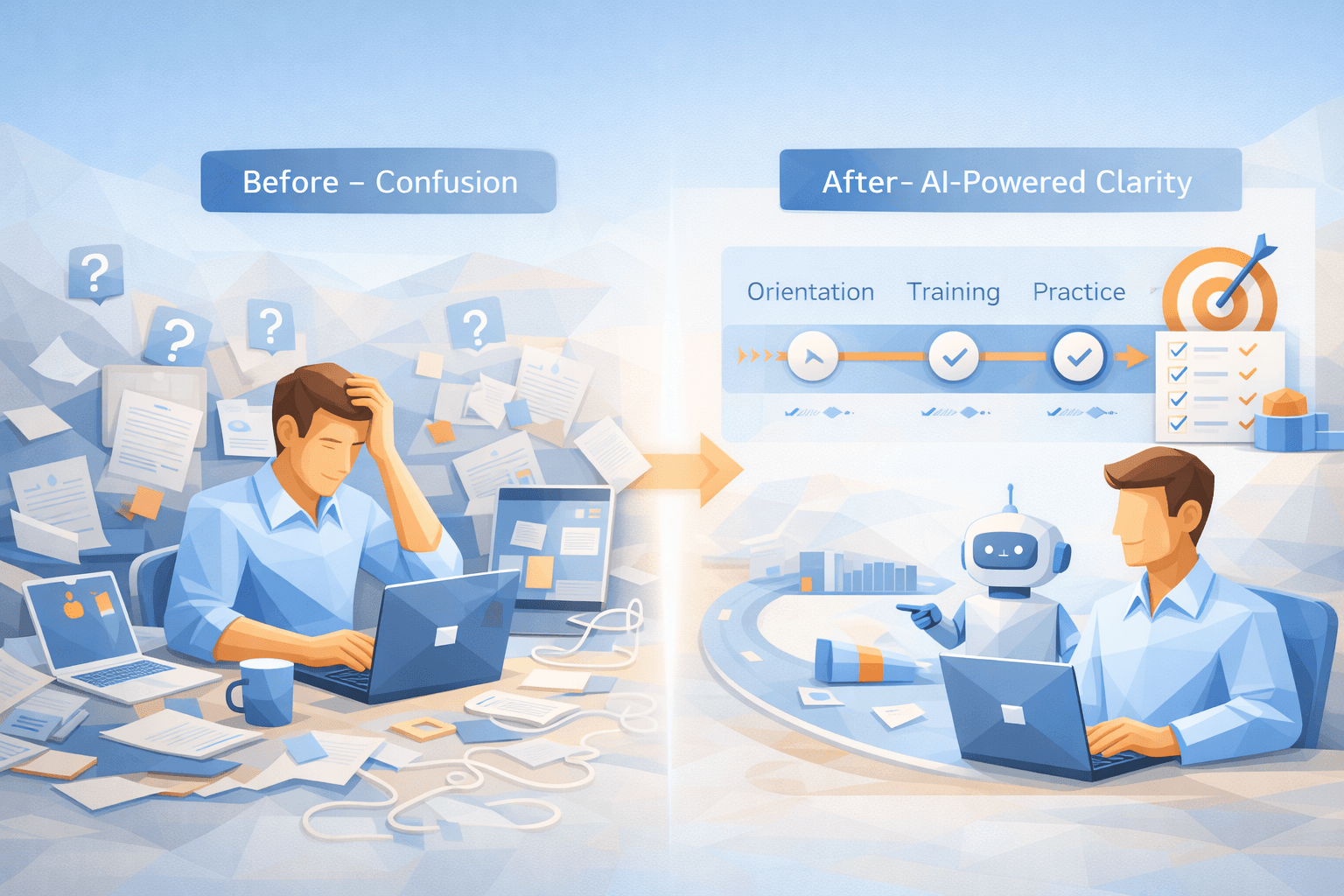
A few months ago, a new hire showed up to their first day excited—but by week two, they were already frustrated. The onboarding materials were scattered across PDFs, outdated Google Docs, and endless Zoom calls. Despite everyone’s best intentions, the learning curve felt steep and unsupported. Sound familiar?
Most learning professionals, HR leaders, and L&D managers have experienced the challenges of traditional onboarding. And in an economy where time-to-productivity directly affects business outcomes, those long ramp-up periods can be costly. Fortunately, AI-powered onboarding offers a smarter, faster, and more personalized approach.
Why Time-to-Productivity Matters
Time-to-productivity measures how long it takes a new hire to become a fully contributing member of the team. According to a report by Gallup, only 12% of employees strongly agree that their organization does a great job of onboarding, which impacts not just performance but also engagement and retention source.
The longer it takes for someone to get up to speed, the more strain it puts on team performance, revenue targets, and morale. For growing companies, inconsistent or outdated onboarding content across departments only compounds the issue.
A compelling case study comes from ComplyAdvantage, a company in the financial technology sector. They leveraged Gong, an AI-powered revenue intelligence platform, to enhance the onboarding experience for their sales team. By analyzing sales calls and generating actionable insights through AI, ComplyAdvantage was able to coach new hires more effectively and personalize their onboarding experience. The result? They decreased time-to-productivity by 50%—a significant reduction that helped new hires close deals and contribute faster.
What Is AI-Powered Onboarding?
AI-powered onboarding uses artificial intelligence to automate, personalize, and streamline the employee onboarding experience. Unlike static onboarding manuals or generic LMS modules, AI tools dynamically adapt based on the learner’s role, pace, and knowledge gaps.
Core features of AI onboarding tools include:
- Automated content creation based on job roles or team needs
- Microlearning modules that are easy to digest and retain
- Adaptive assessments that guide learning paths
- Smart reminders and nudges that support habit-building
- Real-time data for managers and L&D teams to monitor progress
These tools are especially helpful in remote or hybrid work environments, where onboarding can easily fall through the cracks.
Some platforms even allow integration with chatbots or virtual assistants, offering real-time Q&A support for new hires navigating complex processes. For instance, if a new employee forgets how to submit an expense report, an AI assistant can walk them through it step-by-step without waiting on HR.
Benefits of Reducing Time-to-Productivity with AI
Faster Employee Ramp-Up
AI shortens the learning curve by delivering the right content at the right time. Paychex, for example, reduced their sales team’s time-to-productivity by 41% by using an AI-powered eLearning and coaching platform that blended authoring tools, virtual coaching, and video-based role play.
Streamlined and Consistent Onboarding
AI eliminates guesswork and manual errors. Every new hire gets a consistent experience, regardless of who their manager is or where they’re located. This is particularly valuable in distributed or franchise-based businesses where standardization is key.
Personalized Learning Journeys
Using learner data, AI creates individualized onboarding paths. Sales reps, for example, can receive product training modules while customer service hires get scenario-based support simulations. This targeted approach helps employees retain information better and feel more confident in their roles sooner.
Data-Driven Insights for L&D Teams
HR and learning teams gain visibility into who is progressing, where learners struggle, and what content may need to be updated—all without having to chase feedback manually. Dashboards can provide insights into module completion rates, quiz scores, and time spent per topic, helping L&D teams prioritize updates.
A notable example is Deriv, an online brokerage firm, which implemented Amazon Q Business, a generative AI-powered assistant. By integrating this tool, Deriv reduced new employee onboarding time by 45%, enabling new hires to become productive in approximately one week, compared to the previous one-month period. This efficiency was achieved by allowing new employees to access necessary information more quickly and efficiently.
How Mindsmith Supports Rapid Onboarding
Mindsmith leverages generative AI to help learning architects and instructional designers build personalized onboarding flows in minutes. Here’s how it works:
- AI-Generated Content: Enter the new hire's role, and Mindsmith instantly generates relevant microlearning modules.
- Smart Quizzing: Automatically assesses knowledge retention with formative quizzes.
- Instant Updates: Changing a policy or tool? Update your course with a single click.
- Role-Based Personalization: Easily adapt modules for multiple departments or job levels.
Let’s say your company just hired 10 new customer success reps across three time zones. With Mindsmith, you can generate onboarding content tailored to each team’s tools, workflows, and customer scripts—all without writing from scratch. If your CRM tool updates next month, the content can be instantly refreshed using AI.
This level of flexibility and speed means your new hires are better equipped, more confident, and productive sooner. And since Mindsmith is built for ease of use, you don’t need a technical background to create impactful training.
Implementation Tips for HR and L&D Teams
Making the shift to AI-powered onboarding isn’t just about adopting new tech—it’s about rethinking how your team delivers learning experiences at scale. Here’s how to get started and see real results:
- Start with Your Highest-Volume Roles: Begin with positions that have the most hires, highest turnover, or biggest onboarding challenges. These roles often account for a significant portion of training costs and time-to-productivity. Use AI tools to quickly generate personalized modules that cover common onboarding topics like tools, compliance, and team-specific workflows.
- Collaborate with Team Leads and SMEs: Involve managers and subject matter experts early in the content creation process. While AI can draft modules quickly, input from experienced team members ensures accuracy, relevance, and tone alignment. SMEs can help verify that training reflects current systems, company culture, and common new-hire pitfalls.
- Build Feedback Loops: Don't wait until the end of the onboarding cycle to gather insights. Embed quick surveys in onboarding modules, schedule pulse checks after week one and week four, and review quiz performance data. Use this feedback to iterate and continuously improve the onboarding journey.
- Measure and Optimize: Set clear success metrics: time-to-productivity, completion rates, retention after 90 days, manager satisfaction, etc. Leverage built-in analytics dashboards to track learner progress and identify where individuals might be getting stuck. This helps pinpoint content gaps or coaching needs.
- Pilot, Then Scale: Run a test onboarding experience with one department or job family before rolling it out company-wide. This helps you validate the AI-generated content, iron out tech or communication issues, and gather testimonials to support a broader rollout.
- Communicate the Rollout: Onboarding isn’t just the responsibility of HR or L&D—line managers, IT, and even peers play key roles. Make sure everyone understands the new process, their role in it, and how the AI tool supports rather than replaces the human touch. Offer short trainings or job aids for managers to reinforce the new onboarding experience
- Integrate with Existing Tools: AI onboarding tools become even more powerful when integrated with your existing tech stack. Sync it with your HRIS to trigger onboarding flows automatically or connect it to your LMS to centralize learner tracking and reporting
Final Thoughts
AI-powered onboarding is a present-day advantage. And for those of us who have ever been handed a few outdated slides and told to 'figure it out,' the difference is game-changing. What once felt like fumbling through the dark can now be a guided, personalized, and efficient experience.
Tools like Mindsmith make it easier than ever for learning professionals to build smart, flexible onboarding content that evolves with your organization. If you're ready to shift from fragmented onboarding to a streamlined, AI-driven process, now’s the time to make it happen.
Ready to try it yourself? Book a demo with Mindsmith or explore how our AI authoring tool can transform your onboarding experience today.