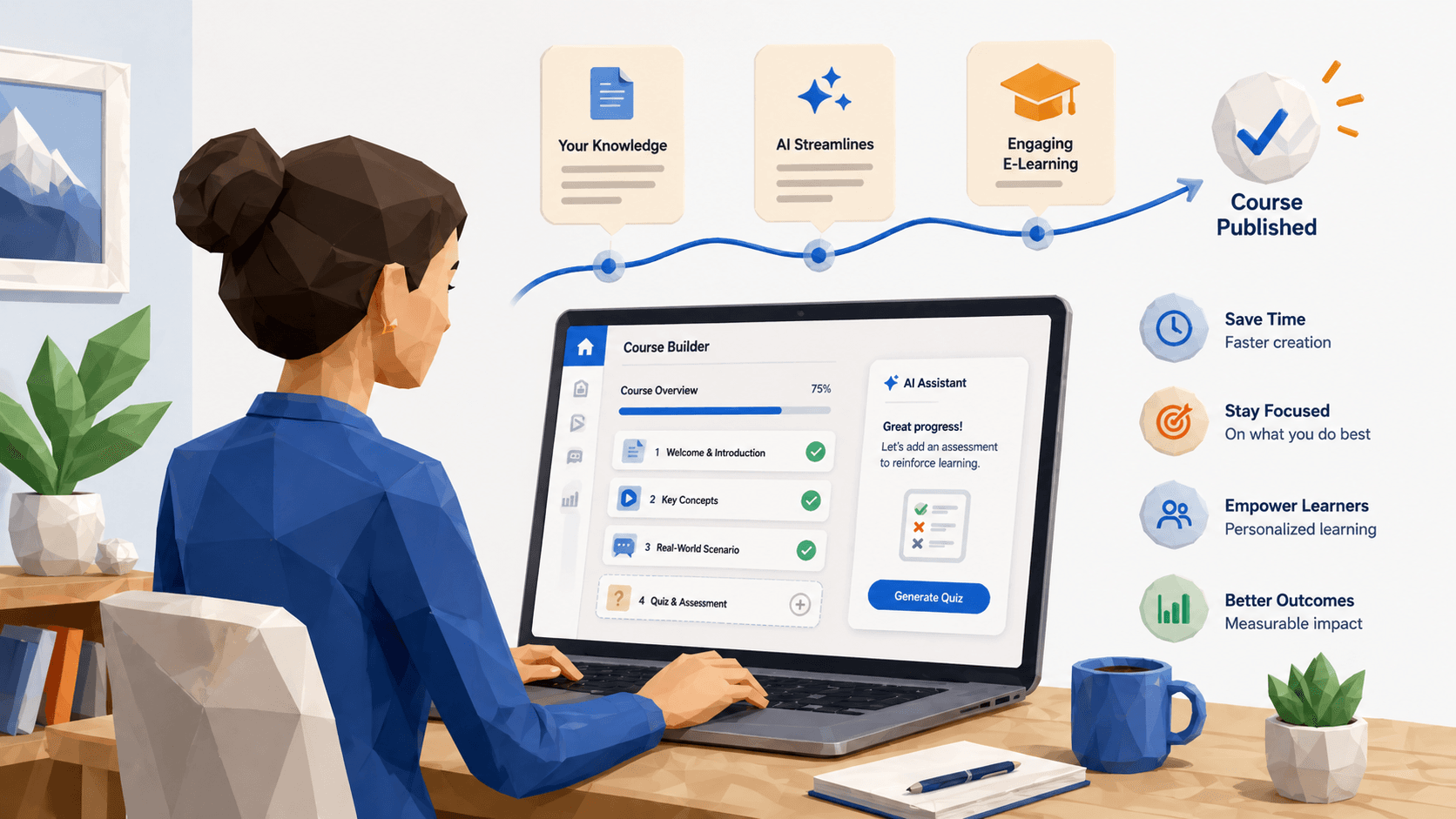
Subject-matter experts (SMEs) are the MVPs of organizational knowledge. They understand processes, products, and protocols inside out. But turning that deep knowledge into digestible, engaging eLearning? That’s a different ballgame.
Traditionally, creating professional learning content required working closely with instructional designers, navigating storyboards, and learning design principles like Bloom’s taxonomy. For busy SMEs, that often meant delays—or worse, no training at all.
Luckily, things are changing.
The Traditional Roadblocks for SMEs
Subject-matter expertise is powerful—but turning that expertise into structured, scalable learning isn't always straightforward. Before we explore how AI is solving this challenge, let’s break down the most common obstacles SMEs face when creating eLearning content on their own.
Lack of Instructional Design Skills
Most SMEs didn’t sign up to become learning architects. Concepts like sequencing, chunking content, or crafting scenario-based assessments aren't typically part of their skill set. And expecting them to learn that on top of their day job? Unrealistic.
Dependence on L&D Teams or Agencies
SMEs often rely on overburdened learning and development teams or hire outside agencies. While effective, it slows things down—and limits the SME’s ability to update or personalize content independently.
Time and Resource Constraints
Even when they want to help, SMEs are already wearing multiple hats. They need tools that make course creation efficient, intuitive, and dare we say, fun.
How AI Changes the Game for SMEs
Enter AI-powered authoring tools. These platforms remove the guesswork and eliminate the barriers between expertise and course creation. Here's how:
1. Structured Content from Simple Prompts
AI can take a few sentences of raw knowledge and propose a full course outline, complete with objectives, section headers, and suggested content formats. This helps SMEs structure their thoughts faster than you can say “learning outcomes.”
A study by McKinsey noted that generative AI can reduce the time to develop digital learning materials by up to 40%, boosting both speed and agility in training creation.
2. Instant Personalization Features
Modern AI tools analyze learner needs and adjust course paths accordingly—think branching scenarios, content variations, or adaptive difficulty levels. Personalized learning is no longer limited to high-budget teams.
In a LinkedIn Learning Report, 83% of organizations said personalized learning is critical to employee development, yet many struggle with implementation. AI bridges this gap.
3. Automatic Assessments and Quizzes
Creating aligned, meaningful [assessments](https://www.mindsmith.ai/blog/ai-powered-assessments-in-elearning?) is often a stumbling block. AI can auto-generate quizzes based on the lesson’s key points, ensuring retention without manual effort.
4. Visual and Multimedia Support
SMEs don’t need to moonlight as graphic designers. AI-powered platforms can now suggest relevant images, video formats, and even voiceovers. This boosts engagement without increasing production time.
5. Localization and Accessibility Built In
Need to train teams across regions or accommodate learners with disabilities? AI now supports auto-translation, screen reader enhancements, and inclusive design recommendations.
According to the [2021 State of Digital Accessibility Report by Level Access](https://www.levelaccess.com/resources/2021-state-of-digital-accessibility-report/?), organizations that focus on accessibility are not only meeting compliance needs but also enhancing user experience and reaching a wider audience—yet many still struggle with implementation. AI tools can make that journey easier by recommending accessibility improvements and automating key adjustments. AI tools make compliance easier.
Mindsmith’s Role in Empowering SMEs
So where does Mindsmith come in? Right in the sweet spot between usability and AI-powered capability.
🔹 Drag-and-Drop Simplicity
Mindsmith removes the steep learning curve. SMEs can build, edit, and publish lessons without watching hours of tutorials.
🔹 AI Co-Pilot for Content Drafting
From generating full lessons to creating engaging summaries, quizzes, and even multimedia prompts—Mindsmith’s AI does the heavy lifting while SMEs stay in control.
🔹 Guided Templates and Built-In Best Practices
Not sure how to start a compliance training? Mindsmith’s templates are structured using solid learning design principles, so SMEs don’t have to wing it.
🔹 Personalized, Adaptive Learning Paths
Mindsmith helps tailor content based on real-time learner data—delivering the right material at the right time, even when the SME hasn’t built multiple versions manually.
Real-World Scenarios
To ground this in reality, here are three SME success stories that illustrate how AI-powered authoring tools are reshaping training across diverse industries.
HR Manager Creates Engaging Onboarding Training
Antisel, a scientific equipment firm based in Greece, needed to revamp its onboarding process for remote new hires during the pandemic. Michael Miliopoulos, the company’s HR Director, turned to the AI video authoring platform Synthesia to solve this challenge—without relying on a video production crew or instructional designers. Using Synthesia’s AI avatars and voice synthesis, he developed personalized onboarding videos tailored to each new employee. These engaging videos replaced traditional PowerPoints and PDFs, delivering consistent and professional training content across the board. The results were impressive: onboarding time was cut by 50%, and the new process received outstanding feedback, earning a Net Promoter Score (NPS) of 100 from the first 18 hires. The initiative also earned the HR team multiple awards for innovation in employee experience.
Sales Team Builds Consistent Product Training at Scale
myPOS, a European payment solutions provider, needed to train its dispersed sales team across multiple countries on product offerings and sales strategies. To do this efficiently, they turned to iSpring Suite, an intuitive authoring tool that allowed subject-matter experts to create interactive online modules—including quizzes, role-playing simulations, and product walkthroughs. Without needing a learning designer, the sales enablement team created engaging content that could be updated quickly and accessed anytime. This resulted in faster onboarding, better knowledge retention, and measurable improvements in sales performance.
Healthcare Compliance Training Built by SMEs
Johnson & Johnson Vision Care needed a better way to deliver compliance training that was both up-to-date and engaging. Using Elucidat, their subject-matter experts created interactive, scenario-based eLearning modules tailored to healthcare professionals across different regions. The intuitive design of the platform meant that SMEs could develop and update content without needing to rely on instructional designers. This led to higher learner engagement, faster content rollouts, and easier global distribution.
Pro tip: Let AI handle the heavy lifting—but your expertise and judgment still matter. Draft smart, test often, and refine as you go.
Conclusion
SMEs are the backbone of organizational expertise—and now, with the right AI-powered tools, they can also be the driving force behind impactful, scalable learning.
AI authoring platforms like Mindsmith remove the barriers of traditional course creation, putting powerful capabilities into the hands of those who know the subject matter best. No more waiting on bandwidth or wrestling with complex tools—just faster, smarter, more personalized training.
💡 Ready to turn your expertise into engaging, personalized learning—without the guesswork?
👉 Try Mindsmith today. It’s intuitive, fast, and built to help you share what you know at scale.
So go ahead, SME. Your next great course might be one prompt away.