Picture a familiar Monday. A compliance deadline just landed, the subject matter expert can spare forty minutes between meetings, and the only existing "training" is a folder of slide decks nobody has touched since the product changed twice over. That's usually where a custom eLearning project actually starts. Not in a strategy off-site, but in a specific, unglamorous problem someone has to solve by a specific date.
That folder of stale decks is the tell. You already know the content needs to be custom. Your compliance requirements are specific to your industry, your product training only makes sense against your actual screens, and your onboarding has to sound like your company, not a stock template. The open question isn't whether to build custom. It's who builds it, and how.
That's what custom eLearning development services actually answer. If you haven't made the custom-versus-off-the-shelf call yet, that decision is worth making first; this guide picks up right after it, once you already know custom is the right move and want to know what the work actually looks like: what a real engagement includes, how the process runs end to end, and what to expect at each stage, whether you're bringing in outside help, standing up an internal pipeline, or using an AI-native platform to do both at once.
What's Included in Custom eLearning Development
A real custom development engagement covers more ground than "someone builds slides for you." Here's what should be on the table.
Discovery and learning strategy. Before anything gets built, someone needs to define the actual behavior change you're after, who the audience is, and what "done" looks like. Skipping this step is the single most common reason custom projects miss the mark: the course gets built, but it doesn't move the number anyone cared about.
Content transformation. Your source material rarely arrives ready to teach from. It's a policy PDF, a recorded walkthrough, a deck your SME built for a different purpose. Turning that raw material into something instructionally sound, sequenced, chunked, and built around how people actually learn, is the core craft of the service. This is also the exact problem teams run into when converting instructor-led training into a digital format: the facilitator guide exists, but it isn't a course yet.
Instructional design. This is where content becomes a course: learning objectives, assessment strategy, scenario design, and the structural decisions that determine whether a learner walks away able to do something or just able to recall something.
Interactive build. Branching scenarios, simulations, knowledge checks, and any interactive elements the content calls for, built and tested inside the platform your team will actually deploy from.
Visual and brand design. Custom means it looks like you: your colors, your fonts, your tone, not a generic template with your logo dropped in the corner.
Review and quality assurance. A pass for instructional accuracy, a pass for subject-matter accuracy with your SMEs, and a technical pass to confirm the course actually functions the way it's supposed to across devices.
Delivery and integration. Getting the finished course into your LMS in the format it needs (SCORM, xAPI, or a direct publish) and confirming tracking and completion data actually flow where they should.
Iteration. The first version is rarely the last version. A good engagement includes a defined path for revisions based on stakeholder feedback and, once it's live, based on how learners actually perform.
How the Process Works
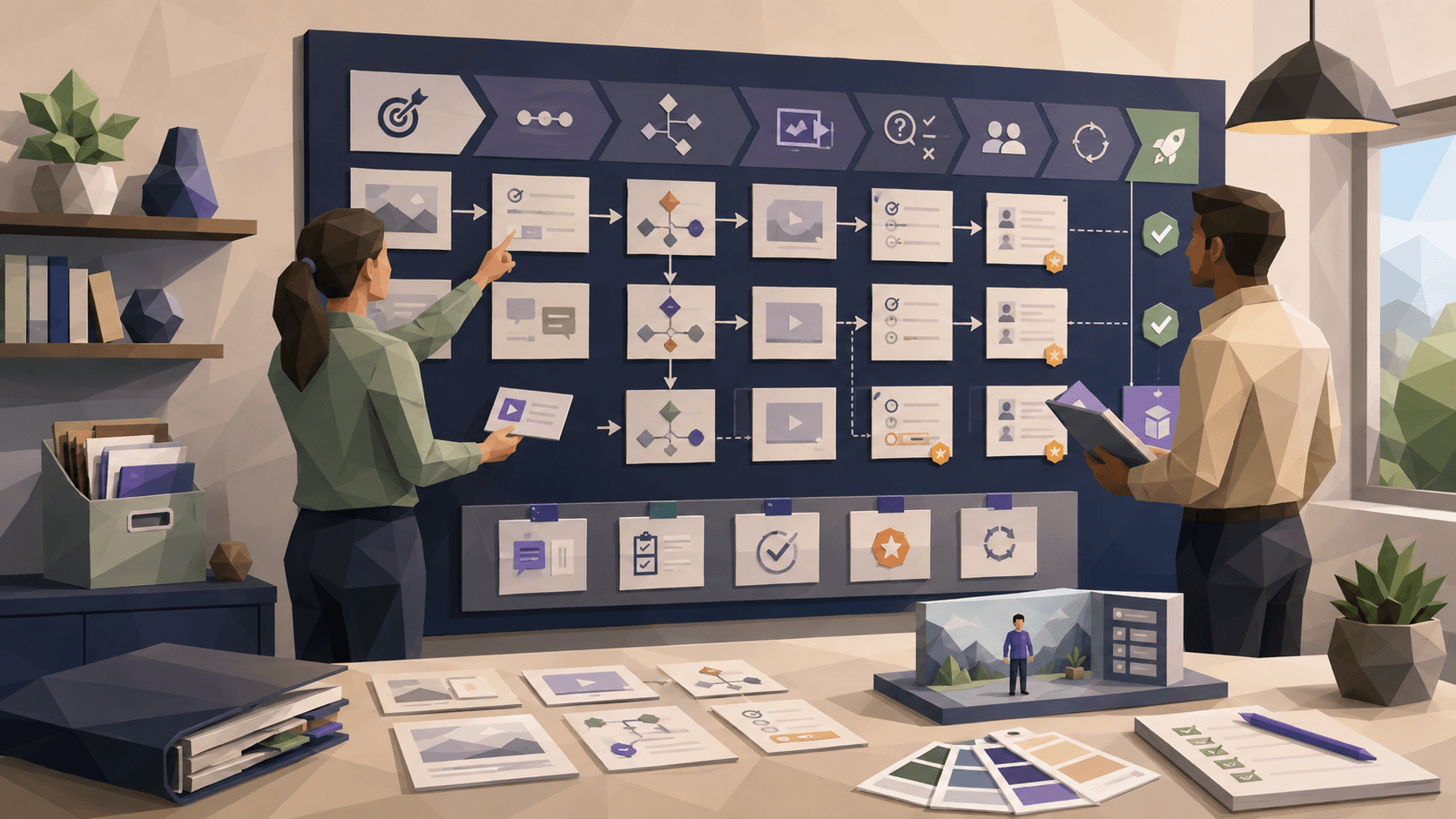
1. Discovery and scoping. A working session to define the audience, the objectives, the constraints (compliance requirements, timeline, existing brand assets), and what source material already exists. This is where the project gets a real shape instead of a vague brief.
2. Storyboarding. Before any interactive build starts, the course gets mapped out: flow, structure, media, and interaction points, so everyone can sign off on the shape of the course while it's still cheap to change. Here's how storyboarding works inside Mindsmith if you want to see that step up close.
3. Build. Source material goes in; a structured, interactive course comes out. This is the step where an AI-native approach changes the math most. Instead of a designer manually building every screen from a blank canvas, the heavy lifting on structure and first-draft content happens fast, which frees the instructional design time for the parts that actually need a human's judgment: nuance, tone, and whether the scenario actually teaches the behavior it's supposed to. It's also why Mindsmith's approach differs from asking ChatGPT or Gemini for a course outline: a raw AI draft still needs to become something trackable, SCORM-ready, and actually deployable, which is where a purpose-built platform picks up the work a general chatbot can't finish.
4. Instructional design and SME review. Two separate checks running in parallel: does this teach correctly, and is this factually correct. Neither one substitutes for the other.
5. Stakeholder revisions. Feedback comes back, changes get made, and the course gets re-reviewed. Building in a defined number of revision rounds up front keeps this stage from sprawling.
6. Launch. The course gets published to your LMS in the right format, tracking gets verified, and the course goes live to learners.
7. Measurement and iteration. Completion rates, assessment scores, and, where it's set up, behavior change back on the job. Custom eLearning isn't a one-and-done deliverable; the best engagements treat launch as the start of a feedback loop, not the finish line.
How the Engagement Differs by Team Size
The reasons enterprise, mid-market, and SMB teams need custom content aren't the same, and if you want that breakdown, it's covered in depth elsewhere. What changes here is the shape of the engagement itself.
Enterprise engagements usually start with procurement: security review, data handling agreements, and a compliance sign-off before any content work begins. Once that's cleared, the volume is the defining factor. Expect a structured intake process for routing many course requests at once, and a review cadence that includes legal or compliance stakeholders alongside instructional design.
Mid-market engagements tend to move faster on the front end since there's usually one or two decision-makers, not a procurement committee, but the revision cycle matters more here. A lean team can't afford open-ended feedback rounds, so the engagements that work best define a fixed number of revision passes up front and hold to them.
SMB engagements are usually the shortest end to end, often a single course built around whatever source material already exists (a process doc, a recorded walkthrough, an existing deck), with one stakeholder approving the final version. The main risk at this size isn't process complexity, it's scope creep: a "quick course" that keeps growing because there's no dedicated team to push back on new requests.
The Honest Version
Custom eLearning development services exist because generic content and internal bandwidth both run out of runway eventually. If you're still weighing whether that's true for your team, the case for custom (and when off-the-shelf still makes sense) is worth reading first. The value here isn't in the word "custom." It's in whether the process behind it is disciplined enough to consistently produce something instructionally sound, on your timeline, without your best designers burning out doing repetitive production work instead of the strategic thinking only they can do.
That's the actual test for any service like this: not how fast it can produce a course, but whether your team is doing more of their best work by the end of the engagement than they were at the start.
Ready to Build Your First Custom Course?
Mindsmith's AI-native agent handles the production work outlined above, turning your source material into an instructionally sound, on-brand course while your team stays focused on the judgment calls only they can make. No procurement cycle required to get started.
See how it works or start building your first course today.