It is 4 PM on a Thursday, and you are staring at your fifth generic “customer service best practices” course this quarter. It covers everything, but applies to no one. Somewhere in a support queue, a rep is about to face an objection this course never mentions because it was written for every company, not yours.
Every L&D team eventually reaches the same fork in the road: buy an off-the-shelf course, or build something made specifically for your people, your process, and your problem. That decision is bigger than it looks. Get it right, and your training actually changes behavior. Get it wrong, and you have spent a budget cycle building a course nobody finishes.
Here is what custom eLearning actually is, what it is good for, and how to know which path is right for your next project.
What Is Custom eLearning?
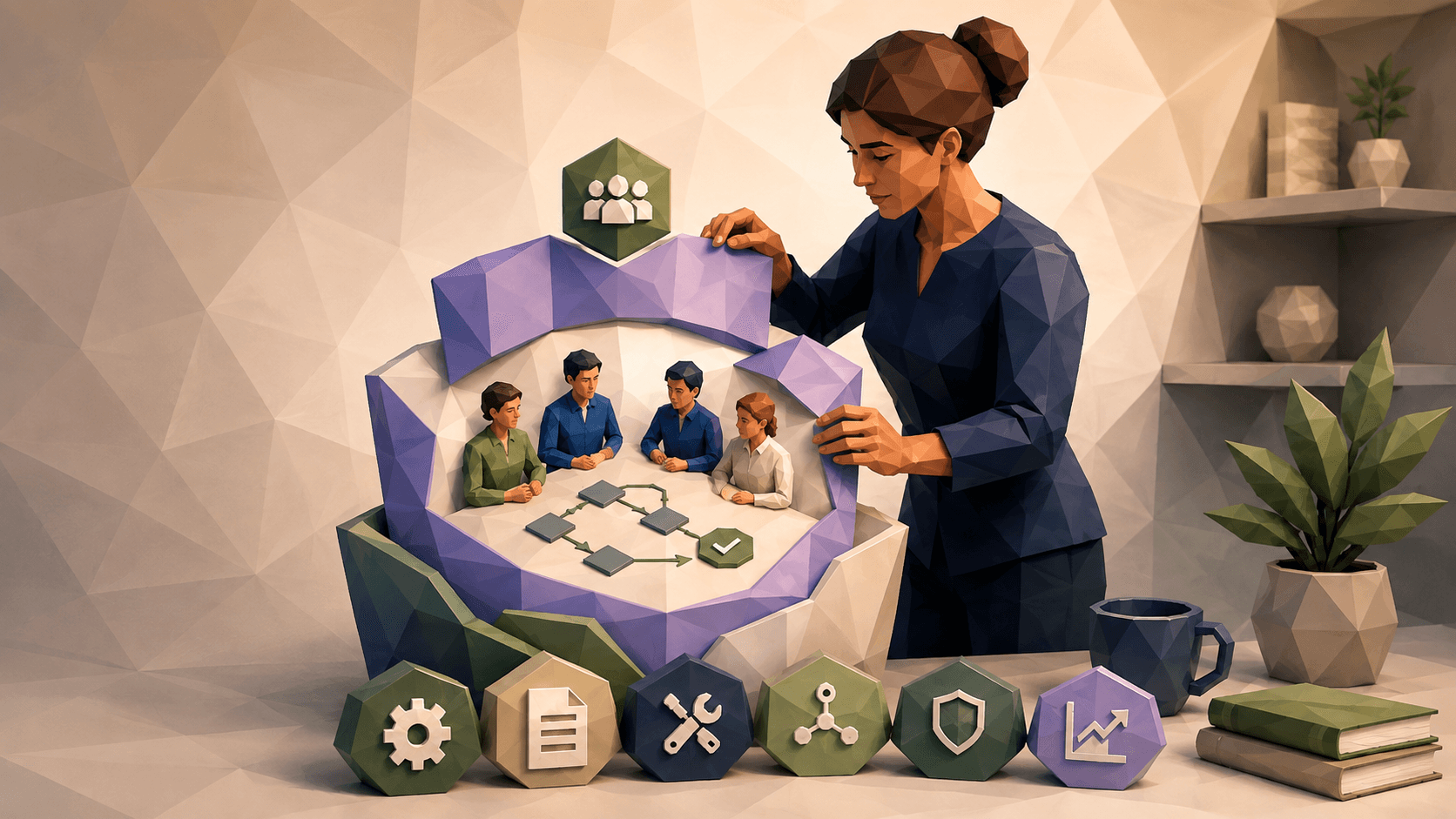
Custom eLearning is training content built from scratch for a specific organization’s audience, tools, workflows, and goals. This is different from off-the-shelf courses, which are designed to work reasonably well for a broad range of organizations.
Think of it as the difference between a tailored suit and one off the rack. Off-the-shelf content covers general topics: workplace safety basics, generic leadership principles, standard compliance frameworks. Custom eLearning covers your systems, your policies, your product, and the exact scenarios your team runs into on a Tuesday afternoon.
A few things that typically make a course "custom":
- Built around your actual content — your SOPs, your software, your product catalog, your compliance requirements
- Branded and voiced like your company — visuals, tone, and examples that feel internal, not generic
- Scenario-based on real situations — role-plays, decision trees, and simulations drawn from what actually happens on the floor or in the field
- Aligned to specific outcomes — a measurable behavior change or skill gap, not a general awareness goal
The Benefits of Custom eLearning
The case for custom content has gotten a lot stronger recently, mostly because AI has changed what's actually possible in eLearning development. Here's what you get when you build custom instead of buying generic:
It closes the gaps that generic content can't reach. Off-the-shelf training is written for a broad audience, which means it has to speak in generalities. Custom content can name your actual tools, your actual objections, your actual edge cases — the stuff your team needs to know that no vendor library could ever anticipate.
It sticks better. Learners remember scenarios that resemble their own work far more than abstract examples. A sales rep who practices handling your pricing objections retains more than one who watches a stock video about "handling objections" in general.
It's a stronger case for L&D as a growth driver. Generic training checks a compliance box. Custom training can be tied directly to a business metric, such as faster ramp time, fewer support tickets, or higher close rates. That makes the ROI conversation with leadership much easier to have.
It protects your brand and your compliance posture. Regulated industries, proprietary processes, and sensitive internal information often can't be trained on generic content at all. Custom eLearning lets you control exactly what's said, how it's said, and where it lives.
It scales expertise instead of just documenting it. Custom content is often the only way to actually capture what your best performers know and turn it into something repeatable for everyone else.
Examples of Custom eLearning in Practice
- Product training — walking new hires through your actual platform, using your actual screens, instead of a generic "how software works" module
- Compliance training with real teeth — scenario-based modules built around your specific policies, your specific regulatory environment, and your specific past incidents
- Sales enablement — role-play simulations built on your pricing, your competitors, and your buyer personas
- Onboarding journeys — a first 90 days built around your org chart, your tools, and your culture, not a generic "welcome to the company" deck
- Process and SOP training — step-by-step walkthroughs of workflows unique to your operation, from manufacturing lines to customer service scripts
- Leadership development — coaching scenarios drawn from real situations your managers actually face, not hypothetical case studies from a textbook
Getting from source material to a finished scenario-based course usually includes a storyboarding step, where you map out the flow, interactions, and media before anything gets built. If you're new to that process, here's how storyboarding works inside Mindsmith.
When Custom eLearning Makes Sense By Team Size
The case for custom eLearning doesn't look the same at every company. What "custom" means, and what's stopping a team from doing it, changes a lot depending on headcount and team structure. Here's how it plays out at three different scales.
Enterprise (5,000+ employees)
At this size, custom eLearning usually is not a question of whether. It is a question of how much, how fast, and how consistently. Large enterprises typically already have an instructional design team, a content library, and a compliance function that expects custom material as the default.
The bottleneck is not skill. It is volume. A 12-person instructional design team supporting 40,000 employees across multiple regions and product lines can only produce so much before quality starts slipping to meet deadlines or deadlines start slipping to protect quality.
This is where Mindsmith functions as a capacity multiplier rather than a replacement for expertise. Your instructional designers remain the people making the decisions on structure, tone, and accuracy, while Mindsmith’s AI-native agent handles the production layer by turning source material into instructionally sound courses at scale. The team does not get smaller. Its output grows.
Mid-Market (1,000–5,000 employees)
This is the segment where the problem is sharpest: real demand for custom content and a team that is stretched to meet it. Mid-market L&D teams are often two or three people supporting a workforce the size of an enterprise, without the enterprise-sized team to match.
The result is a backlog. Requests for custom onboarding, product training, and process documentation pile up faster than a small team can build them. This usually means falling back on generic content out of necessity, not preference.
Mindsmith is built for exactly this gap. It lets a small team produce enterprise-volume output without adding headcount, so custom training stops being the work that gets triaged out of the roadmap. The work your best people would do anyway, including the judgment calls and instructional design, gets protected. The production time around it shrinks.
SMB (Under 1,000 employees)
Smaller companies often have no dedicated eLearning function at all. Training gets built by whoever has time, usually someone in HR or operations who is already wearing several other hats. Custom eLearning has historically felt out of reach in this context, not because it would not help, but because it is assumed to require a specialist and a production budget that do not exist yet.
This is the segment where Mindsmith changes the math the most. You do not need a background in instructional design to start. You need the source material you already have and a platform that can turn it into a real course without a multi-week production cycle. Custom eLearning stops being a “someday, when we hire for it” project and becomes something a lean team can ship this quarter.
When Off-the-Shelf Still Makes Sense
Custom eLearning isn't the answer for everything, and a good instructional designer knows when to reach for the cheaper, faster option instead:
- Widely applicable topics like general workplace safety, harassment prevention basics, or common software certifications
- Small audiences where the cost of building custom content outweighs the benefit
- Time-sensitive compliance deadlines where a pre-built course covers the requirement adequately
- Early-stage pilots where you're still validating whether a training program is worth investing in at all
The honest framing: off-the-shelf content answers "does this topic need to be taught." Custom content answers "does this specific team need to change this specific behavior." Different questions, different tools.
The Real Barrier to Custom eLearning
If custom content is so much more effective, why does every team not build it at every scale? The answer is cost and time. Regardless of team size, custom eLearning has historically meant weeks of instructional design work and a production pipeline that competes with everything else on the roadmap. That is the barrier Mindsmith is built to remove, no matter how large or lean your team is.
For a closer look at what an AI-native approach actually changes in that pipeline, see how AI course creator tools are redefining eLearning.
Making the Call
Before your next project, ask three questions:
- Is this knowledge unique to us, or common to every company in our industry?
- Can we tie this training to a number leadership already cares about?
- Do we have the time and tooling to build something custom without blowing the timeline?
If the answer to the first two questions is yes, custom eLearning is worth the investment, and it does not have to cost you the timeline it used to.
Mindsmith’s AI-native authoring platform turns the source material you already have into a fully custom, instructionally sound course in hours rather than weeks. This works whether you are a lean team of one or a specialist team of twenty.
See how it works or start building your first course today.